Decoding First Closes in Emerging VC
· By Dr. Michail Michailow · Insights
What actually separates funds that close from those that don't?
Reaching a first close is one of the most critical milestones for emerging venture funds. It signals early validation from LPs and creates the momentum needed to move from fundraising into active investing. Yet, many funds struggle to reach this point, even when some appear similar on the surface.
This raises an important question: what actually differentiates funds that successfully close from those that remain stuck in fundraising? While many would assume that factors such as age, team size, or persistent LP outreach may play a decisive role, the data suggests a more nuanced picture.
This article analyzes data from almost 700 emerging venture funds that successfully completed Decile Group's VC Lab accelerator program and focuses on two key areas:
What does not matter: Factors that show no meaningful differences between funds that close and those that do not.
What matters: Factors that consistently distinguish funds that successfully reach a first close.
What Does Not Matter
Several commonly assumed indicators of fundraising success show no meaningful differences between funds that have successfully closed and those still working toward a first close. Across different types of statistical tests, the data consistently shows that the following factors do not distinguish outcomes.
Age Does Not Matter
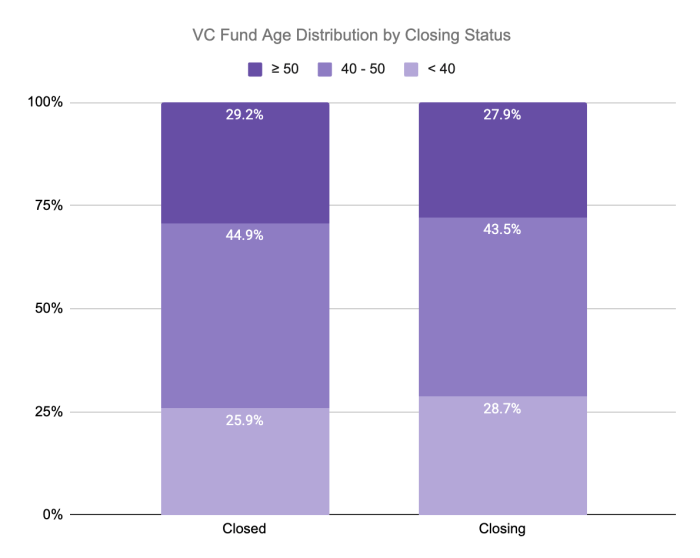
T-test analysis shows no statistically significant difference in GP age between closed and struggling funds. Managers of closed funds have an average age of 44.9 years, compared to 44.5 years for struggling funds, t(521) = 0.52, p = .61 (d = 0.04). Correlation analysis similarly shows no relationship between age and closed amounts, r = .10, p = .12.
These results indicate that age does not distinguish emerging managers that reach a first close. Both younger and older managers appear equally represented across outcomes, suggesting that fundraising success is not tied to age alone, which is an encouraging signal for younger managers entering VC.
Team Composition Does Not Matter
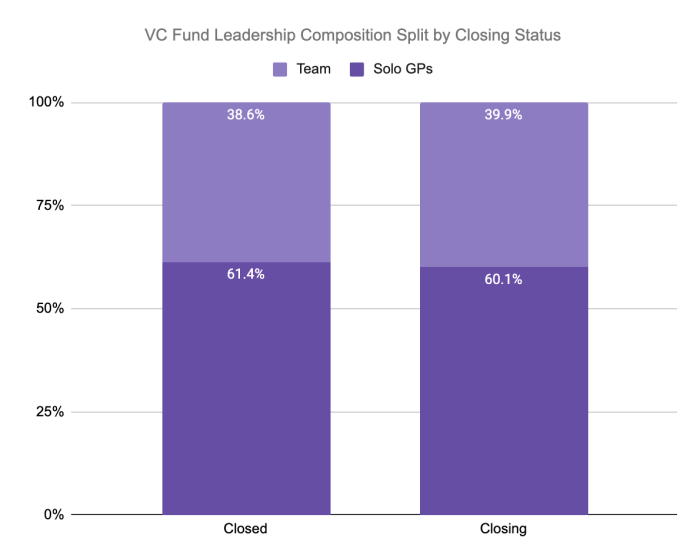
Relative comparisons show no differences in leadership structure between closed and struggling funds. Solo GPs lead 61% of closed funds and 60% of funds still working toward a close, while team-led funds account for 39% and 40% respectively. Across both groups, solo-led funds remain approximately 1.5x more common, indicating that leadership composition is nearly identical regardless of fundraising outcome.
T-test results reinforce this finding. Team size averages 1-2 fund managers across both groups, with no statistically significant difference, t(667) = 0.23, p = .82 (d = 0.02). Correlation analysis also shows no meaningful relationship between team size and closed amounts, r = .11, p = .07.
Together, these results suggest that team composition is not a defining factor in early fundraising success, as emerging managers appear to achieve similar outcomes whether launching solo or with a partner. The overall preference to launch solo may reflect how emerging managers seek to retain decision-making autonomy and move more quickly during the early stages of fundraising.
Pitching Volume Alone Does Not Matter
T-test results show no significant difference in the number of LPs pitched between closed and struggling funds. Both groups fall closest to the 26-50 LP range, with no statistically meaningful variation, t(333) = 1.60, p = .11 (d = 0.15). Correlation analysis further confirms that the number of LPs pitched is not related to closed amounts, r = .05, p = .55.
These findings suggest that simply increasing the number of LPs approached does not translate into better fundraising outcomes. While pitching LPs is an integral part of the process, the data indicates that volume alone is not sufficient. More targeted outreach, particularly toward warm and relevant LPs, may be more important than broad or unstructured outreach efforts.
What Matters
While some factors show no meaningful differences, certain indicators consistently distinguish funds that successfully reach a first close. These differences are most evident in early fundraising momentum, prior experience and network size.
Prior Angel Experience Matters
T-test results show that managers of closed funds have significantly higher levels of prior angel investing experience. Closed fund managers average closer to the 6-10 investment range, compared to 3-5 investments for struggling funds, t(641) = 3.82, p < .001 (d = 0.30).
Correlation analysis supports this pattern. Prior angel investing experience is positively correlated with closed amounts, reflecting a relatively modest yet statistically significant relationship, r = .20, p < .001. Emerging managers closing ≥ $10MM report 6-10 prior investments, around 42% more than those closing < $1MM.
These findings suggest that a track record of angel investments may help signal experience, judgment, and network access to LPs, while also demonstrating the ability to source, evaluate, and support deals in practice. This combination can strengthen credibility during fundraising and provide LPs with greater confidence in a manager's ability to deploy capital effectively.

Prior VC Experience Matters
T-test analysis shows that prior VC experience is more common among managers who successfully close. Approximately 60% of GPs in closed funds report prior VC experience, compared to 50% among struggling funds, t(643) = 3.10, p = .002 (d = 0.24).
Prior experience in venture is also positively correlated with closed amounts, reflecting a relatively modest yet statistically significant relationship, r = .14, p < .05. Managers closing ≥ $10MM report prior VC experience in 78% of cases, about 1.5x more often than those closing < $1MM.
These results indicate that familiarity with venture processes and LP expectations may help managers navigate fundraising more effectively, while also signaling credibility and institutional readiness to potential investors. This experience can provide clearer positioning, more structured communication, and greater confidence in engaging with LPs throughout the fundraising process.
LinkedIn Presence Matters
T-test results show a statistically significant difference in LinkedIn followers between closed and struggling funds. Managers of closed funds are generally closer to the >2K follower range, while struggling funds are closer to 1-2K followers, t(321) = 5.54, p < .001 (d = 0.54).
This difference highlights variation in professional visibility across groups. A broader network or stronger presence can increase reach, enable warmer introductions, and reinforce credibility with LPs, supporting more effective fundraising.
Stage Focus Matters
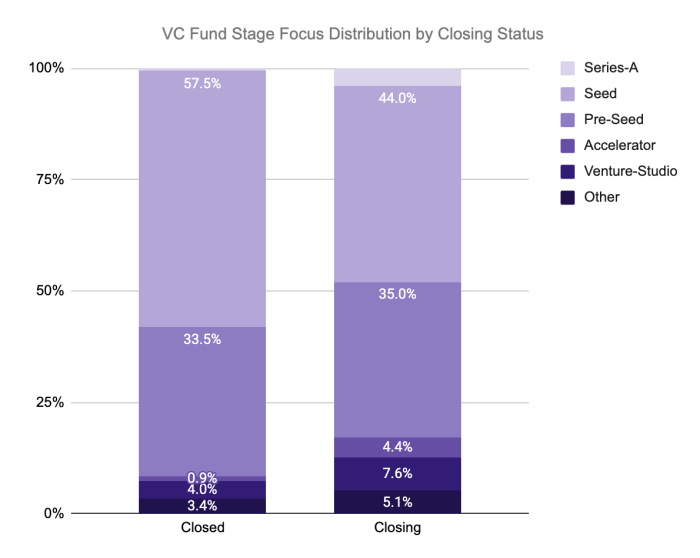
Relative comparisons show notable differences in stage focus between closed and struggling funds. Funds that successfully close are 1.3x more likely to focus on seed-stage investing, representing 58% of closed funds compared to 44% of those still fundraising. In contrast, funds still working toward a first close are 2-4x more likely to focus on venture studio, accelerator, or Series A strategies.
These patterns suggest that emerging managers pursuing seed-stage strategies may find it easier to reach a first close, while more operational fund models, such as venture studio and accelerator funds, may take longer to gain traction due to higher levels of complexity and the need to communicate a more involved execution model to LPs.
Early Momentum Matters
Relative comparisons highlight early fundraising traction as one of the strongest differentiators. Funds that successfully reach a first close receive an average of $3.6MM in soft commitments within their first six months, which is 1.9x more than funds still working toward a close. In relative terms, these funds secure 49% of their target fund sizes, representing a 1.8x larger share than struggling funds.
These differences point to a clear gap in early fundraising progress. Funds that accumulate more capital early are more likely to reach a first close and also tend to secure a larger portion of their targets within the same timeframe. This early traction helps build momentum and signals credibility to LPs, making it easier to build confidence and attract additional commitments.
Key Takeaways
Reaching a first close is a defining milestone for emerging venture funds. It determines whether a fund can move from fundraising into active investing and signals early validation from LPs.
The data shows that many commonly assumed indicators do not differentiate outcomes. Team composition, age, gender, and the number of LPs pitched show no meaningful differences between funds that successfully close and those that continue fundraising.
Instead, a nuanced set of factors clearly stands out. Funds that reach a first close report higher levels of prior investment experience, with managers typically in the 6-10 prior angel investments range and around 60% reporting prior VC experience. They also show stronger professional visibility, averaging closer to the >2K LinkedIn follower range. In terms of strategy, these funds are more frequently focused on seed-stage investing and are able to build strong early momentum, securing $3.6MM in soft commitments within their initial six months of fundraising and reaching 49% of their target fund sizes.
Key takeaways include:
Use visibility to strengthen access. A stronger network and online presence can improve reach, credibility, and access to the right LPs.
Prioritize warm and relevant LP relationships. Outreach volume alone does not matter, making targeted engagement and strong introductions more effective.
Leverage and communicate experience. Prior angel and VC experience signal credibility, helping LPs assess judgment, network access, and ability to deploy capital.
Build early traction deliberately. Securing meaningful soft commitments early increases both the likelihood of reaching a first close and the share of capital raised.
The path to a first close is becoming clearer. Funds that combine credible experience, professional visibility, focused positioning, and early momentum are best positioned to convert soft interest into closed capital.