Signaling Ethical Intent in Emerging VC
Are funds rewarded for stating a clear ethical mission in their thesis?
Most emerging funds do not explicitly position around ethics. Funds with no ethical signal in their thesis have consistently represented the majority since 2020. Funds with a clear ethical mission have declined sharply, largely replaced by funds that reference ethical considerations in passing or as buzzwords rather than as a defining purpose.
Funds with an explicit ethical mission raise early capital more effectively. Funds with explicit ethical positioning secure 1.2x more early soft commitments, cover 1.2x larger portions of their fund targets within their initial six months of fundraising, and convert commitments into signed LPAs 1.3x faster than funds with implicit or neutral ethical positioning.
Funds with explicit ethical positioning are more likely to close. Funds with explicit ethical positioning tend to set leaner fund targets, hence close larger portions of their targets, and are up to 1.2x more likely to reach a first close than funds with implicit or neutral positioning.
Funds with ethical positioning are led by more diverse and younger managers. Funds with either explicit or implicit ethical positioning are 1.8x more likely to be led by at least one woman GP than funds with no ethical signal, and are up to 1.5x more likely to be launched by managers under 40.
Venture capital has long been defined by the pursuit of outsized financial returns. Yet a growing conversation in the industry asks whether the values of fund managers also shape the funds they build. The Mensarius Oath, a practitioner-led ethical commitment for investment managers, captures this aspiration. The main principles, including integrity, fairness, equality, and a commitment to avoiding harm, set a standard for how managers should conduct themselves. Whilst the Mensarius Oath governs behavior, a deeper question remains: does an ethical orientation also manifest in what managers choose to invest in and why?
The investment thesis is the clearest public signal of what a fund stands for. For managers who have internalized ethical principles, those values might be expected to surface in how they articulate their fund's purpose. For others, the thesis may reflect a purely commercial calculus, with no reference to the world the fund operates in. The gap between the two is measurable and, as this article shows, consequential.
This article analyzes investment theses from approximately 700 emerging funds that successfully completed Decile Group's VC Lab accelerator program. Each thesis was classified along a spectrum of ethical positioning using a framework developed and validated through an iterative coding process. The analysis covers five areas:
The definition and framework of ethical positioning.
The evolution of ethical positioning from 2020 to Q1 2026.
Fund demographics by ethical positioning, including gender and age.
Fund structure and strategy by ethical positioning, including stage focus and fund size.
Fundraising performance by ethical positioning, including early commitments, conversion speed, and fund closes.
Definition of Ethical Positioning
Ethical positioning refers to the degree to which a venture capital fund's investment thesis reflects an ethical intent beyond the pursuit of financial returns:
Explicit Ethical Positioning. Ethics is the goal and market is the vehicle. The thesis explicitly commits to advancing ecological or human welfare, reducing inequality, promoting diversity and inclusion, or avoiding harm, with the ethical mission foregrounded as the primary reason the fund exists.
Implicit Ethical Positioning. Market is the goal and ethics is the context. The thesis pursues mainly economic value and investment returns, with an ethical dimension peripherally referenced through focus on an inherently social sector or underserved population.
Neutral Ethical Positioning. Market is the goal and ethics is not referenced. The thesis pursues solely economic value and investment returns with no reference to human or ecological welfare, inequality, diversity or inclusion.
Evolution of Ethical Positioning
The distribution of ethical positioning across emerging funds has shifted meaningfully since 2020. Neutrally positioned funds have consistently represented the majority, ranging from 56% to 62% across the past six years. Funds with implicit ethical positioning have grown steadily from 26% in 2020 to 38% by Q1 2026. The share of funds with explicit ethical positioning has declined sharply over the same period, from 15% in 2020 and 2021 to just 2% by Q1 2026, representing a 6.5x decline since 2023 alone.
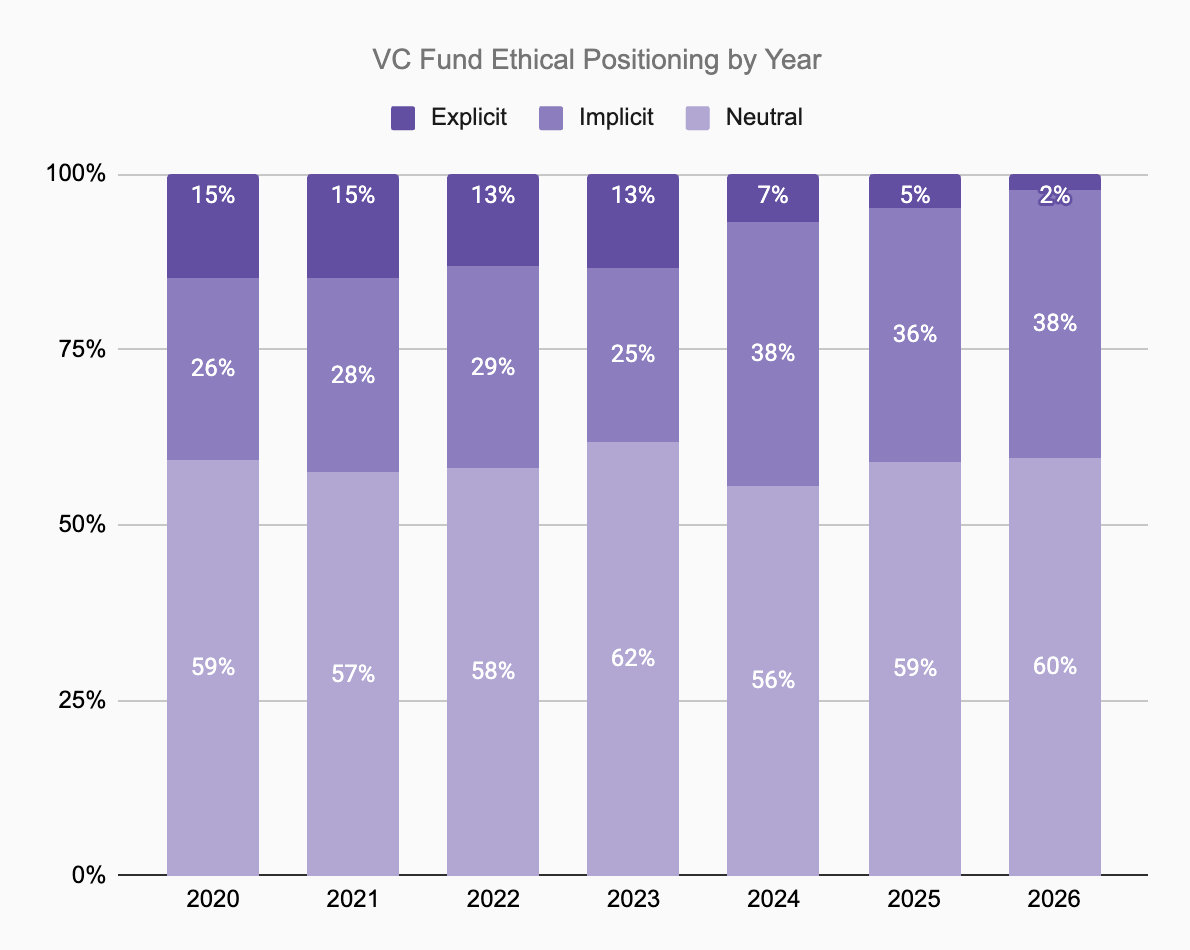
The decline in funds with explicit ethical positioning has been matched almost entirely by the rise of implicitly positioned funds. The share of neutrally positioned funds has remained nearly unchanged throughout the period, suggesting that the shift is not a retreat from ethical considerations, but a change in how managers choose to express them. Managers appear increasingly likely to signal ethical intent through sector focus or population targeting rather than through explicit mission language.
This shift likely reflects a broader pattern in how ethical language is used in investment theses. Terms like "impact", "sustainability", and "purpose-driven" have become widespread in venture capital, to the point where their presence in a thesis carries less signal than it once did. Managers may be responding to LP skepticism toward explicitly ethical language, or to a belief that commercial framing is more persuasive. Whatever the reason, the data suggests that explicit ethical intent is being diluted into implicit signals and buzzwords rather than stated as a defining purpose.
This is a missed opportunity. As the following sections show, explicitly positioning a fund around an ethical mission carries measurable fundraising advantages. Managers who genuinely intend to make the world a better place through their investments are better served by saying so clearly.
GP and Fund Demographics by Ethical Positioning
Beyond the distribution of ethical positioning across the landscape, the data reveals meaningful differences in who leads funds across all three positioning categories, particularly in terms of gender and age.
Women GPs Favor Ethically Positioned Funds
Gender composition differs substantially across ethical positioning categories. Among funds with neutral ethical positioning, 80% are all-male teams and only 20% include at least one woman GP. Among funds with explicit and implicit ethical positioning, all-male teams represent 65% of funds in both categories, and around 35% include at least one woman GP — 1.8x more than funds with neutral ethical positioning. All-female teams show the sharpest contrast, representing 21% of funds with explicit ethical positioning and 23% of funds with implicit ethical positioning, compared to just 8% of funds with neutral ethical positioning.
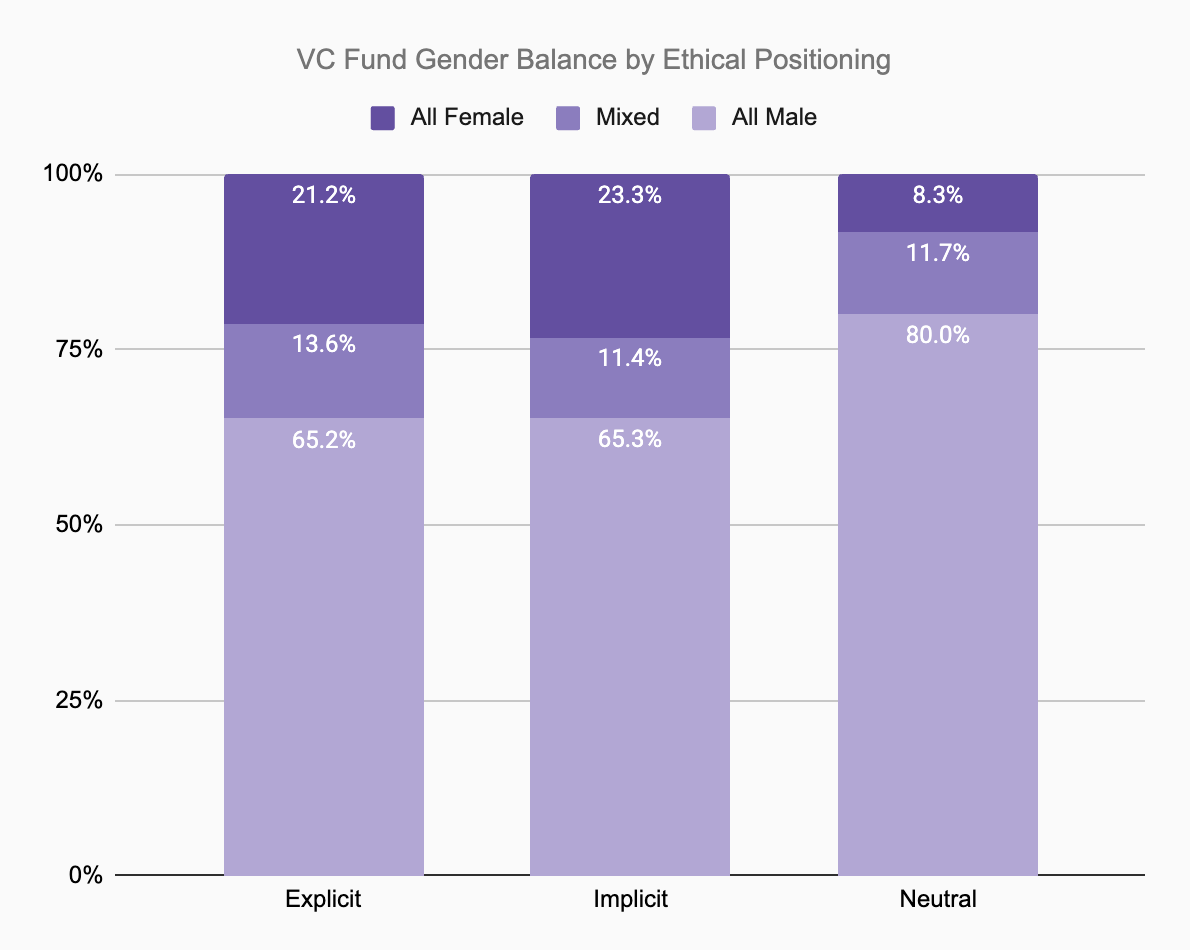
This pattern likely reflects a broader tendency for women in leadership to bring values-driven perspectives to fund formation. In emerging VC, this appears to translate into a stronger propensity to build funds around explicit or implicit ethical missions. The data suggests that diversity in fund leadership and ethical positioning tend to reinforce each other, both in how funds are built and how they are positioned to the market.
Younger GPs Prefer Ethically Positioned Funds
Age distribution follows a similar pattern. Among funds with implicit and explicit ethical positioning, 33% to 35% of leadership teams respectively have an average age under 40, compared to just 24% among funds with neutral ethical positioning. Younger leadership is therefore up to 1.5x more common among funds that signal an ethical dimension in their thesis.
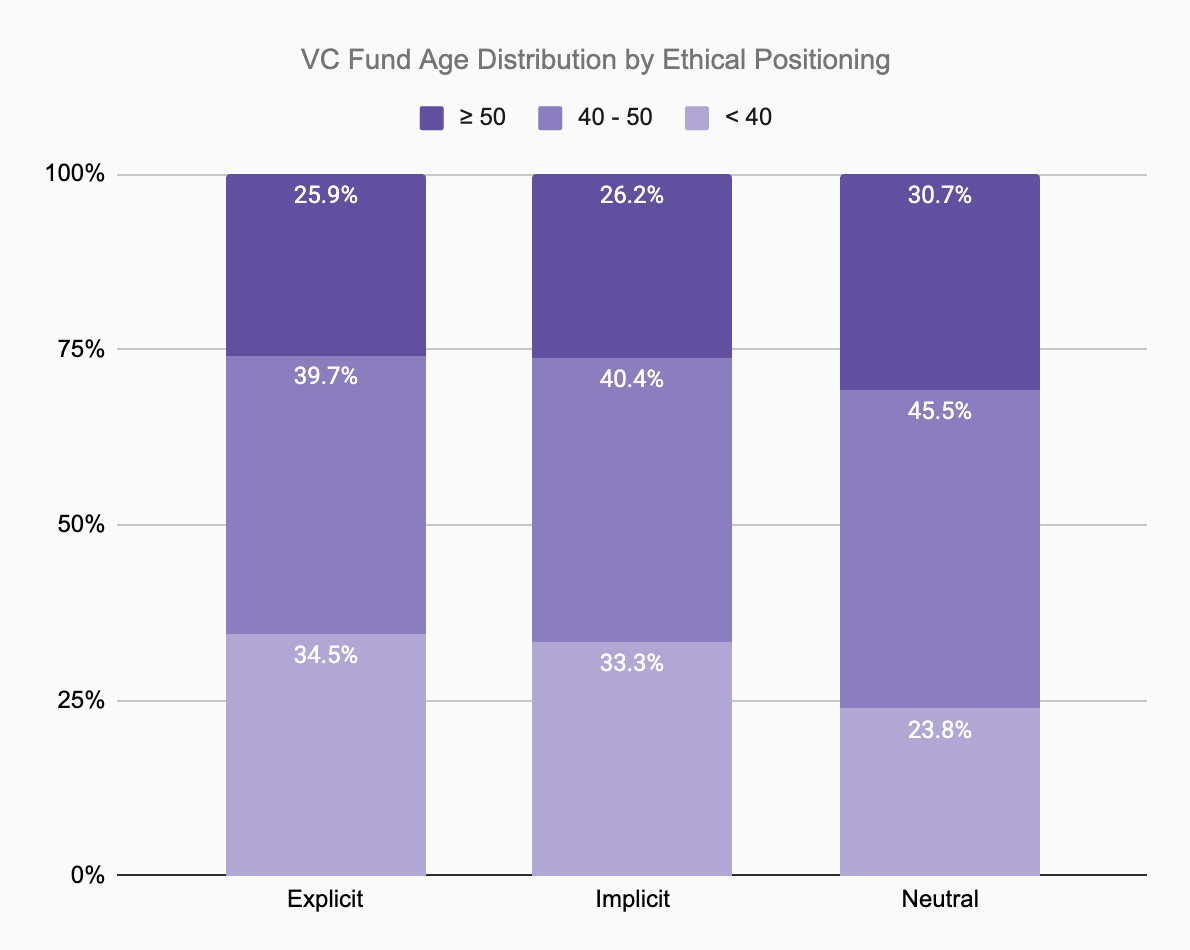
This pattern may reflect generational differences in how managers think about the role of capital in society. Younger GPs have grown up in an era of heightened awareness around climate, inequality, and social justice, which may translate more naturally into how they articulate their fund's purpose. It may also reflect the influence of ecosystems that increasingly emphasize ethical intent as part of fund formation, attracting younger managers who see it as integral to a credible investment thesis.
Fund Structure and Strategy by Ethical Positioning
Ethical positioning is associated with meaningful differences in who leads emerging funds, but shows little relationship with how those funds are structured or what stages they target. Fund size is the notable exception.
Solo GPs Prevail Across All Ethical Positioning Categories
Solo GPs lead 61% of funds with explicit ethical positioning, 63% of funds with implicit ethical positioning, and 61% of funds with neutral ethical positioning. Team-led funds account for the remaining 39%, 37%, and 39% respectively.
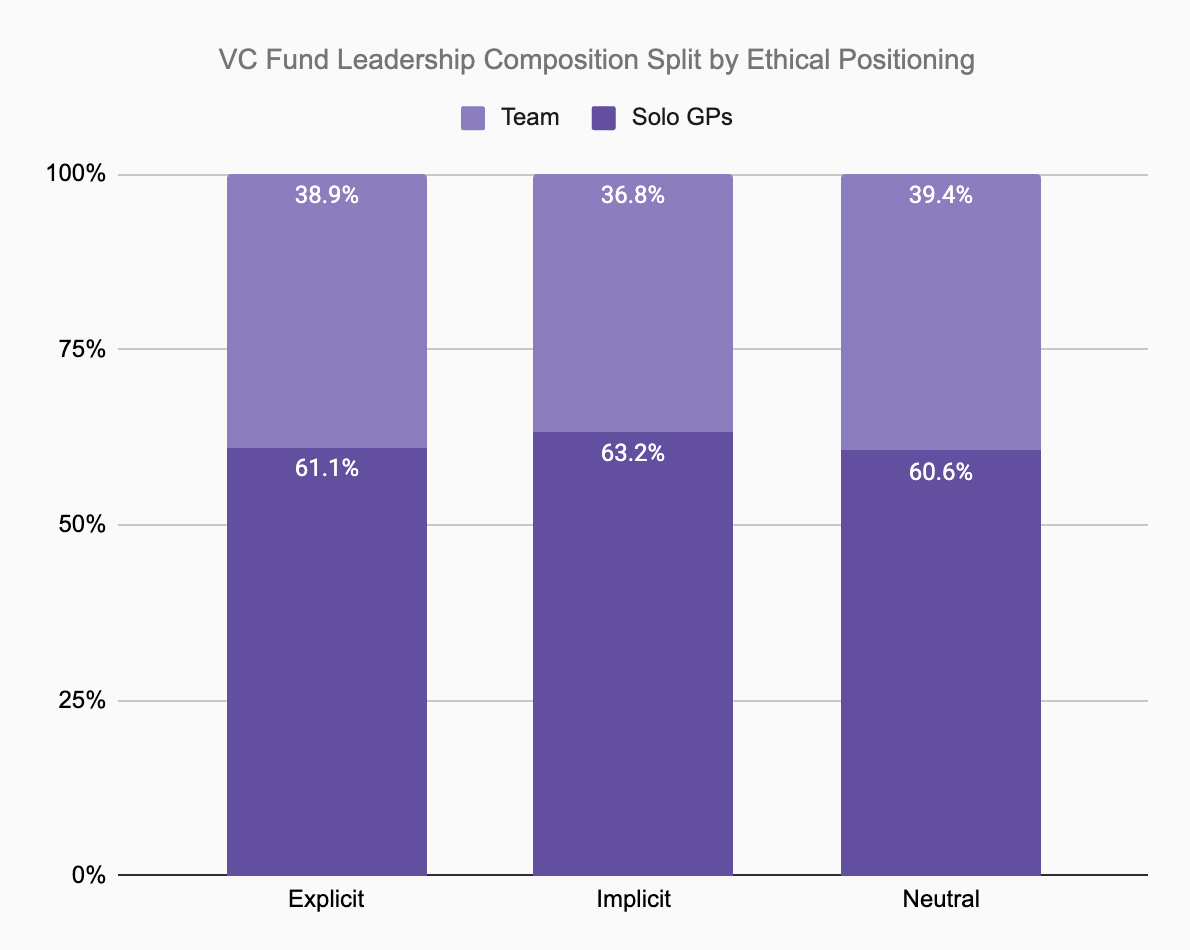
These near-identical distributions suggest that ethical positioning has no bearing on whether managers choose to launch solo or with a partner. The decision appears driven by other factors, such as the desire to move faster, maintain full decision-making autonomy, or avoid the complexity of early team coordination. The prevalence of solo-led funds across all categories likely reflects a broader tendency among emerging managers to launch independently before expanding their teams as their firms grow.
Seed Stage Dominates Across All Ethical Positioning Categories
Stage focus is similarly consistent across ethical positioning categories. Seed-stage investing is the preferred strategy for the majority of emerging funds regardless of ethical positioning, representing 54% of funds with explicit ethical positioning, 53% of implicitly positioned funds, and 46% of neutrally positioned funds. Pre-seed investing accounts for a further 33% to 35% across all three groups, whilst Series A investments represent only around 2% across all categories.
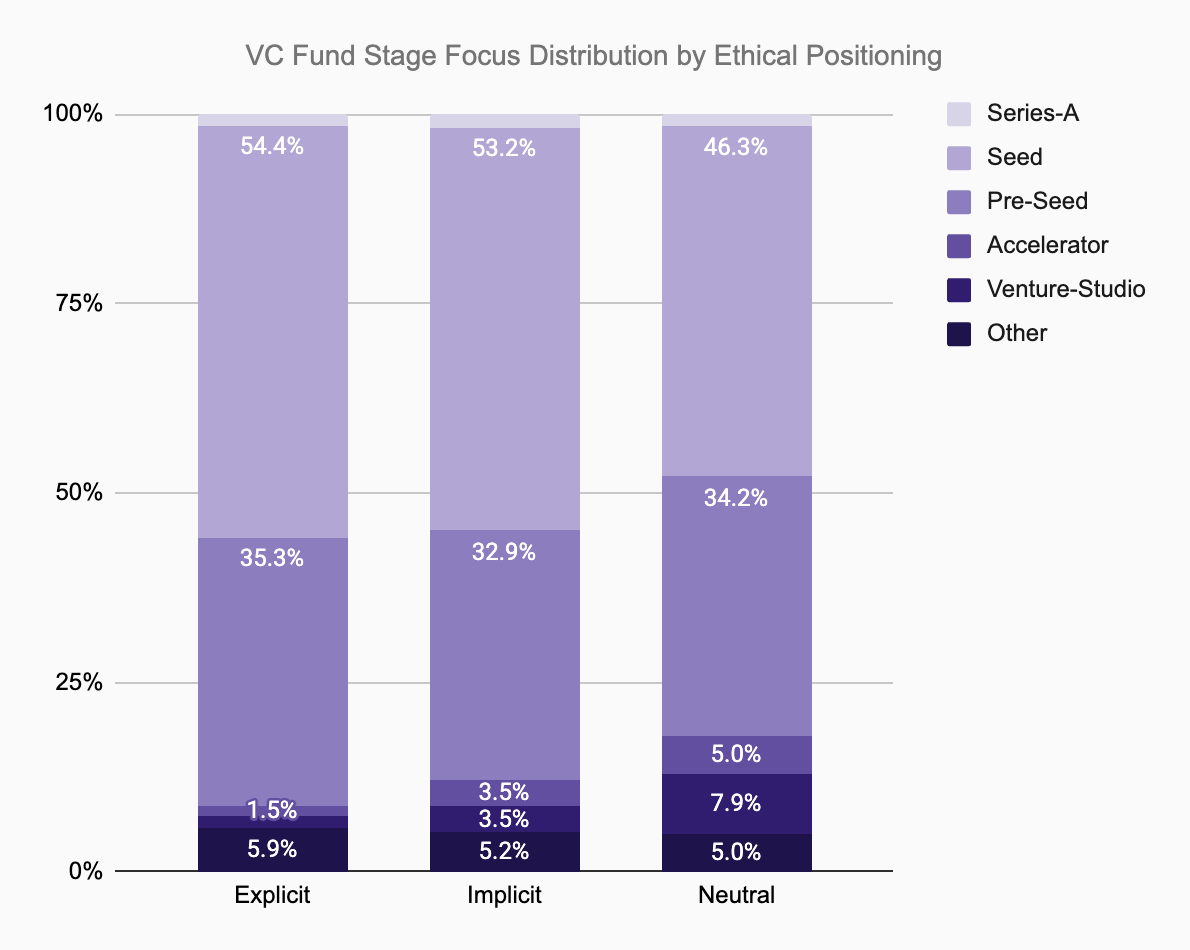
Two notable exceptions emerge at the margins. Venture studio funds are over 5x more common among funds with neutral ethical positioning than funds with explicit ethical positioning, and over 2x more common than funds with implicit ethical positioning. Accelerator funds follow a similar pattern, being over 3x more common among funds with neutral ethical positioning compared to funds with explicit ethical positioning.
This concentration likely reflects the nature of these investment models. Venture studios and accelerators tend to emphasize operational value creation, building companies at scale and accelerating their growth toward commercial viability. The fund manager's role in these models is often closer to that of an operator or builder, which may mean that the investment thesis naturally foregrounds the model and its track record rather than a specific ethical mission or purpose.
Funds with Explicit Ethical Positioning Set Leaner Targets
Fund size is the area where ethical positioning shows its most consequential structural difference. Funds with explicit ethical positioning set average target sizes of $8.4MM — 1.2x smaller than the $10.2MM and $10.0MM targets set by implicitly and neutrally positioned funds respectively.
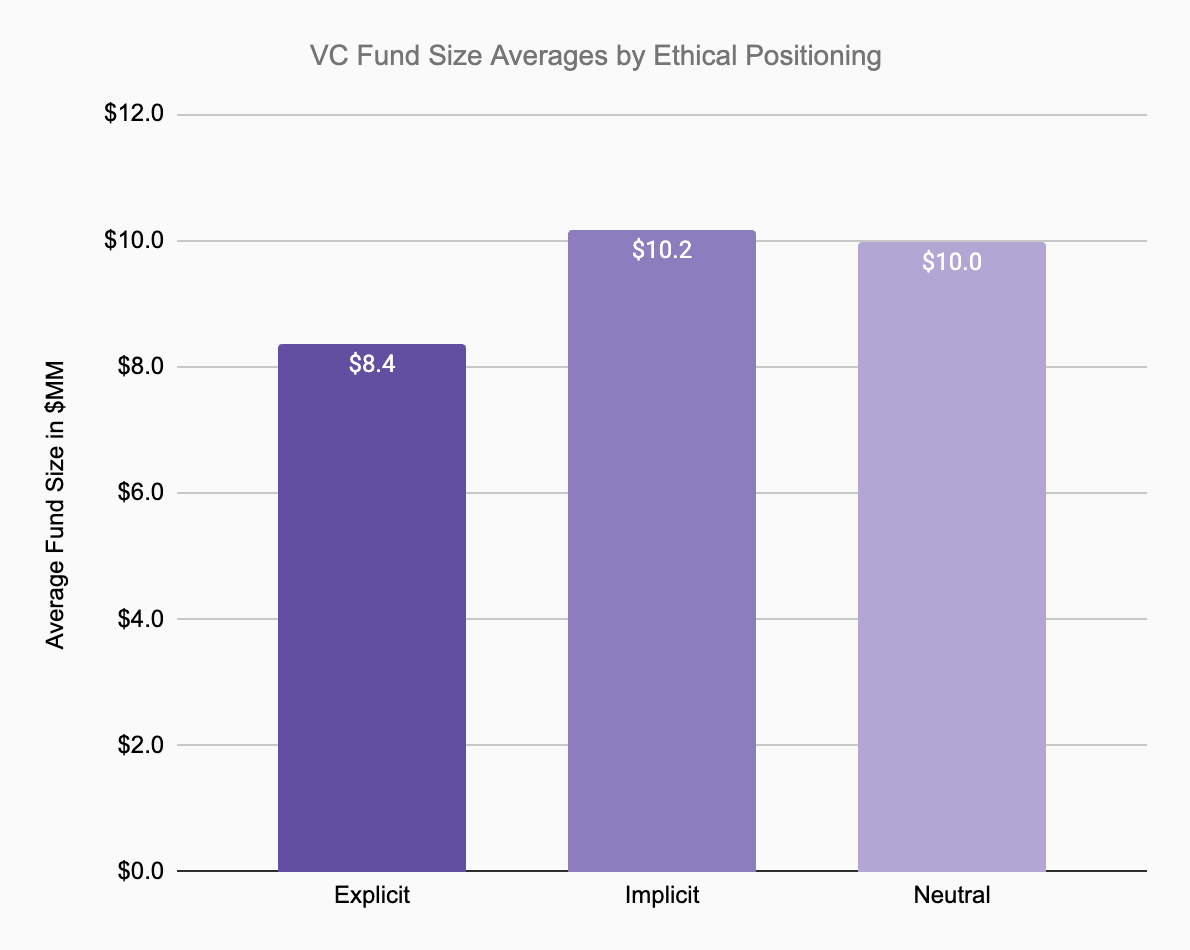
Explicitly positioned funds draw from a more concentrated LP base of values-aligned investors who are fewer in number but tend to commit with stronger conviction. Setting a leaner target is a natural response to this reality. As the following section shows, this discipline appears to work in favor of explicitly positioned funds, producing stronger relative fundraising performance and a higher likelihood of reaching a first close.
Fundraising Performance by Ethical Positioning
Ethical positioning is associated with distinct fundraising patterns. Funds with explicit ethical positioning generate stronger early momentum and convert commitments faster, while funds with neutral ethical positioning tend to close larger amounts in absolute terms. However, when performance is measured relative to fund size, the picture shifts again.
Explicit Ethical Positioning Supports Early Commitment Volume
Within the first six months of fundraising, funds with explicit ethical positioning obtain an average of $3.0MM in soft commitments — over 1.2x more than funds with implicit or neutral ethical positioning. When measured relative to fund size, the advantage is equally clear. Funds with explicit ethical positioning secure 45% of their target in early soft commitments, compared to 33% for both funds with implicit and neutral ethical positioning.
Explicit ethical positioning appears to generate stronger early conviction among values-aligned LPs, who may require less time to evaluate fit and move more quickly to offer commitments. To a relevant audience, a clear and authentic ethical thesis can therefore function as a fundraising accelerator, not just a statement of intent.

Explicit Ethical Positioning Accelerates Commitment Conversion
Funds with explicit ethical positioning convert soft commitments into signed and legally binding LPAs within an average of 12 weeks — 1.3x faster than the 16 weeks generally required by funds with implicit or neutral ethical positioning.
This speed advantage likely reflects the quality of LP relationships that ethically positioned funds tend to cultivate. LPs who share a fund's ethical orientation may require less convincing and less time to formalize their commitment, allowing explicitly positioned funds to build traction and credibility within a shorter fundraising window.
Neutral Ethical Positioning Leads in Absolute Close Amounts
When it comes to first close amounts, funds with neutral ethical positioning close up to 1.2x larger amounts than funds with implicit or explicit ethical positioning. Their access to a broader and more easily accessible pool of return-driven LPs likely contributes to this advantage.
Funds with neutral ethical positioning are not restricted to values-aligned investors, allowing them to target a wider universe of LPs focused primarily on financial returns. This broader reach naturally supports larger absolute closes and likely explains the gap in absolute performance.
Explicit Ethical Positioning Wins in Relative Terms
When fundraising performance is measured relative to fund size, the picture shifts back in favor of funds with explicit ethical positioning. Due to their leaner fund sizes, funds with explicit ethical positioning close up to 1.3x larger portions of their targets and are up to 1.2x more likely to reach a first close compared to funds with either implicit or neutral ethical positioning.
For emerging managers, reaching a first close is a defining milestone. It signals credibility to future LPs and unlocks the ability to begin deploying capital. The data suggests that explicit ethical positioning, combined with disciplined fund sizing, is a more effective strategy for achieving this milestone than either implicit signaling or neutral ethical positioning.

Key Takeaways
Ethics in venture capital is more than a question of how managers behave. It is visible in what they choose to invest in and why, and it carries measurable consequences for who joins their teams and how their fundraising unfolds.
The data tells a clear story. Explicitly positioning a fund around an ethical mission is associated with greater gender and age diversity in leadership, stronger early fundraising momentum, faster LP conversion, and a higher likelihood of reaching a first close. Yet the share of explicitly positioned funds has fallen sharply since 2020, replaced largely by implicit signals and ethical language used as a backdrop rather than a defining purpose.
This suggests that many emerging managers who genuinely care about making the world a better place are not saying so clearly in their thesis, perhaps out of concern that explicit ethical framing will deter commercially minded LPs, or because the language of ethics has become so diluted in the industry that it feels less credible. The evidence points in the opposite direction. Explicit ethical positioning resonates with a specific and committed LP base, generates faster commitment and conversion, and reflects a fund sizing discipline that improves relative performance.
This article does not argue that ethical positioning is a requirement for building a successful emerging fund, or that focusing on economic value and financial returns is in any way a lesser strategy. It does, however, offer a clear message for managers who genuinely intend to invest around ethical principles. Signaling that intent explicitly, rather than in passing or through borrowed language, is associated with a stronger response from LPs and better fundraising outcomes overall.
Key takeaways include:
Explicit ethical positioning and strong fundraising performance are not mutually exclusive. Funds with explicit ethical positioning attract stronger early commitments, convert faster, and are more likely to reach a first close than funds with implicit or neutral ethical positioning.
State the ethical mission explicitly. Managers who intend to invest around ethical principles should foreground that intent in their thesis. Funds with implicit ethical positioning carry less weight with LPs than those with explicit ethical positioning.
Right-size the fund to the mission. Funds with explicit ethical positioning tend to set leaner targets and close larger portions of those targets. Disciplined and realistic fund sizing is a strategic advantage, not a constraint.
Build diverse teams around a shared purpose. Funds with explicit or implicit ethical positioning are more likely to include women in leadership and younger GPs. Diverse teams and ethical positioning appear to reinforce each other in how funds are built and how they perform.
The message for emerging managers is clear. If you intend to invest ethically, say so explicitly. The data suggests that clarity of purpose attracts the right LPs, builds stronger momentum, and produces better relative outcomes. Explicit ethical positioning is not a trade-off against performance. If anything, the data suggests it’s an advantage.