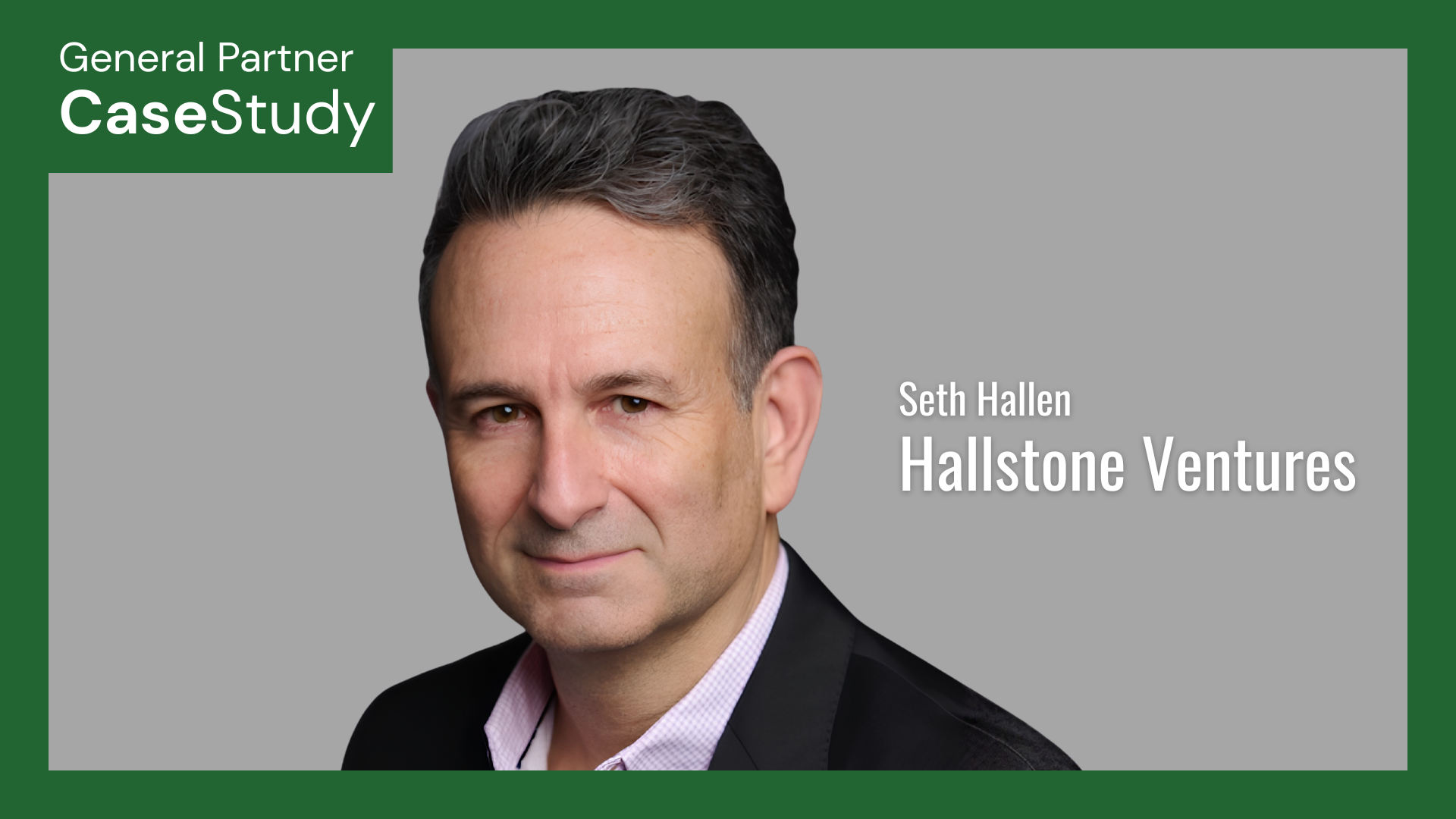
Seth Hallen
Every great movie starts with a casting call.
The director already knows exactly who they need. The relationships are long. The decisions are deliberate. By the time the cameras roll, the cast is the movie. The screenplay matters, the budget matters, the soundstage matters. But cast it wrong and none of the other stuff matters at all.
That's how Seth Hallen built the cap table of his first fund.
He didn't fundraise the way most first-time managers do. He didn't pitch strangers, knock on doors of family offices, or burn six months on cold outreach hoping for a warm intro. He cast the LP base of Hallstone Ventures the way a director casts a film. He went to the people who'd already been in his world for two and a half decades.
CTOs and senior technology leaders across the studios, streamers, Hollywood agencies and Big Tech companies. Roughly 70 LPs in total, almost every one of them a senior technology, operating, or domain leader inside the very ecosystem the fund invests in.
Rounding out the cap table: Decile Capital as the institutional anchor, a family office, a successful GP from another fund, and a handful of seasoned professional LPs.
He didn't need to convince any of them what the thesis was. They'd been living inside it. They knew Seth had been too.
Hallstone Fund I, in plain numbers
Hallstone Fund I surpassed its $10M target. Los Angeles-based. Seed stage. Backing the AI infrastructure layer of media, entertainment, and advertising. Four thesis areas: creator infrastructure, AdTech and monetization rails, immersive and spatial media systems, and frontier media technologies. Original target was $10M. Original LPA fundraising window allowed two years. Seth closed it in one.
The fund is intentionally sized, the thesis is sharp, and the cap table is one of a kind.
But this case study isn't really about the fund. It's about the 25 years of operator work that made the fund possible, and what that means for any other Hollywood lifer thinking about doing the same thing.
Media and Entertainment runs on technology that nobody sees
Watch any piece of modern media move from idea to audience: a film, a livestream, a creator video, a brand campaign, a game environment. What looks simple on screen is supported by a sophisticated technology layer underneath: workflow systems, cloud infrastructure, distribution rails, rights and provenance tools, monetization pipes, audience data, and the software that helps creative work find its market.
That is the world Seth Hallen has spent 25 years close to. Traditional Hollywood was his training ground, but the lesson was bigger than Hollywood: media does not scale without infrastructure.
Hallstone is built around that next-generation infrastructure layer, especially the tools powering creators, advertisers, media operators, immersive workflows, and new forms of media that are only beginning to emerge.
"AI is accelerating a rebuild of the software layer behind how media is created, distributed, measured, protected, and monetized," Seth says. "Hallstone was formed to back the founders building that enabling layer. Storytelling will always be core to human experience, but the systems that support it are changing fast."
Hallstone is not a thesis about media AI. It's a thesis about the infrastructure that lets AI-driven media companies actually work: the monetization rails creators depend on, the fan engagement systems that deepen audience relationships, the distribution and discovery layers that help audiences find what they care about, and the architecture that determines whether a new media company can actually scale.
That's a layer almost no general-partner-without-operator-roots can pattern-match. You have to have lived inside it. Seth has.
The 1995 cold open
Every great Hollywood story has a cold open. Here's Seth's.
In 1995, a young man arrived in Los Angeles. He doesn't know where he'll live. He doesn't know what job he'll do. He just knows two things: he loves storytelling, and he loves technology. And he knows Los Angeles is the only place on Earth that lives at the intersection of both.
"I knew exactly that I wanted to be in this industry," Seth says. "I've always been passionate about storytelling and movies and television shows. And I love technology. A lot of people don't realize how much technology is underneath all of what we watch at the theater, on our TVs and on our mobile devices.. It's fundamental to it. So I came out here and I leaned heavily into the post technology side of it for most of my career."
What followed was a quiet, deliberate climb. Global operations at Sony New Media Solutions. Global operations at Panavision's Light Iron. Senior leadership at Pixelogic and Testronic. Nine years as President of the Hollywood Professional Association (HPA), the trade body that represents the people actually working at the intersection of creativity and technology..
It's the kind of career that earns deep respect inside the industry and is almost completely invisible outside it.
Which is exactly why nobody else could have raised this fund. Seth wasn't pitching the technology leadership of Hollywood. He was one of them. He just happened to be the one who decided to start writing checks.
The third act starts at 57
There's a line Seth dropped in our conversation that I haven't been able to stop thinking about.
"It's the first time I love getting up every day. It doesn't feel like work. It's more like the work I was meant to be doing. I just love every minute of it. I work every day including weekends, and people ask me how I do that? My answer is simple: because it doesn't feel like work. I don't want to be doing anything else."
Then:
"I feel like it's the first time I've finally figured out what I want to be when I grow up."
He's 57.
The Silicon Valley story is the 28-year-old who quits Google to start a fund. Hollywood is structurally different. Hollywood is a third-act town. The best directors get better in their 60s and 70s. The best producers don't peak until they've sat through enough flops to understand what actually makes a film land. The third act is where the work compounds.
Seth's third act is starting now.
"I've been an operator for decades," he says, "and I've been involved with lots of transactions on the buy and sell side. And now, all of it was training for this." Then he invokes Steve Jobs's line about connecting the dots backwards.
This is what it looks like for an emerging manager when the operator track has been right the whole time.
The Muay Thai dojo
Here's the part about Seth that surprised me most.
He's a martial artist. Muay Thai. Krav Maga. He's not graceful, by his own admission. That's part of the point.
"When the coach comes up and teaches you how to do it, you listen," he says. "Following the instructions of the gurus is how you get good. Otherwise how are you going to learn a skill that you don't know? The same part of the brain that says, 'Okay, Coach is telling me this is the technique, so this is how I'm going to practice it. That's it.' And then once you learn it, you make it your own."
Most managers do not approach their first fund this way. Most managers walk into a fundraise with two decades of operating experience and the assumption that they already know how to raise.
Seth approached it the way he approached learning to kick.
He almost didn't go to VC Lab, the accelerator program at Decile Group that launches over 50% of new venture capital firms each year. He hesitated. He had every reason on paper to skip it.
He went anyway.
"VC Lab might be the single smartest professional decision I ever made," he says now. "I almost didn't go to VC Lab. I can't imagine that parallel. There's no world where I would have closed this fund, especially this quickly."
He went through Cohort 16 and won recognition as a top performer. He started raising during the sprints. The first close hit in March 2025 while he was still inside the program.
"The VC Lab program just works," he says. "It's the right training. I don't know how else to put it. I'm old enough and wise enough to say, that doesn't sound like the way I would have done it, but I'm going to put that aside and just follow their lead. Other people might not do that because we all think we're know-it-alls. We all come assuming we know what we're doing."
The original LPA gave him until March 2027. Seth gave himself until March 2026. He reached his target oversubscribed, a full year ahead of the original fundraising window.
He still joins the VC Lab cohort calls today, post-graduation, to stay sharp, and has been asked to come back to deliver presentations to recent cohorts about fundraising. The dojo never closes.
The supporting cast
A first-time fund manager rarely lands a venture partner bench that reads like Hallstone's. Most have to settle for friends who'll show up for a quarterly call. Seth cast operators.
Leon Silverman. Executive leadership across Walt Disney Studios, Netflix, LaserPacific, and Eastman Kodak.
Andy Beach. Former CTO of Media and Entertainment at Microsoft. Led cloud production strategy, AI workflows, major enterprise partnerships.
Claire Lee. Former Silicon Valley Bank executive leading startup banking. Former Principal at Microsoft Ventures running seed-stage strategic partnerships.
Dave Kochbeck. Former founding CTO of Live Nation. Former Chief Scientist at Silicon Valley Bank.
These are not advisors. These are operators who have already done the things Hallstone's portfolio companies will need to do. When a Hallstone-backed founder needs to design a rights-aware media workflow, build creator monetization or fan engagement infrastructure, navigate enterprise video and AI adoption inside a brand, or integrate into the cloud, distribution, and advertising systems that modern media companies rely on, the introduction is one phone call. The advisory layer of the fund is at the operating level of the stack a media-tech founder will have to navigate, from creator platforms and corporate video to advertising, distribution, and next-generation production workflows.
"Our LPs don't just provide capital," Seth says. "They bring expertise."
Why media and entertainment's next decade probably looks like this
The media and entertainment industry has been through a structural reset over the last fifteen years, with streaming changing the economics, distribution models, and technology needs of the industry. That shift has expanded beyond traditional streaming services into YouTube, TikTok, and creator-led platforms, changing how audiences discover, consume, and engage with content. Most lifers don't survive even one wave that significant.
Seth has been on the technology side of that evolution. He's been an angel investor for a few years before launching Hallstone, and his angel checks were performing well. The shape of an obvious opportunity formed.
But the bigger pattern is this: media and entertainment is now the latest industry whose foundational software is getting rebuilt by AI, and there is a small, growing class of operator-led funds positioned exactly right to back the next wave of companies inside it. These funds are too small for traditional institutional LPs. They're too specific for fund of funds. They are exactly the right size for a sharp, sector-focused thesis raised from a domain expert LP base.
Hallstone is the textbook example.
The mega-fund commentary class will tell you it's a terrible time to be a VC. That is not what is happening at the sub-$100M fund level. What is happening is that operators with 20 or 25 years inside specific industries are launching sharp, sector-focused funds, raised from the actual experts inside those industries, written from an entirely different LP base than traditional institutional capital. Seth's fund is one of them.
This is the playbook. Hallstone is what it looks like when an operator from the technology side of media and entertainment runs it correctly.
What comes next
Hallstone is now actively deploying. The press wave is rolling out across this week, with venture, media, and business outlets beginning to cover the fund and the operator-led story behind it.
But the real next chapter for Seth is the portfolio. The four thesis areas (creator infrastructure, AdTech rails, immersive/spatial media, frontier media tech) are exactly where the next decade of media and entertainment gets rebuilt. The cap table is the operating network. The portfolio is the future infrastructure layer. The work starts now.
And if Seth's first 25 years are any indication of his next 25, the third act is going to be a good one.
About Hallstone Ventures
Hallstone Ventures is a Los Angeles-based seed fund backing founders building AI-driven infrastructure powering the future of media, entertainment, and advertising. The firm focuses on creator infrastructure, AdTech and monetization rails, immersive and spatial media systems, and frontier media technologies. Founded by 25+ year media-technology operator Seth Hallen, who previously held leadership roles at Panavision/Light Iron, Sony, Pixelogic, and Testronic, and served as President of the Hollywood Professional Association for nine years. Learn more at hallstoneventures.com.
About Decile Group
Decile Group is on a mission to turn venture capital into a force for good. The company runs VC Lab, the leading accelerator for new venture capital firms worldwide, launching over 50% of all new VC firms started each year. Decile Group also runs Decile Hub (the agentic VC back office), Emerging Institute (the institutional LP readiness program), and Decile Capital (a top-performing fund of funds). Learn more at decilegroup.com.
Media Contact:
Hallstone PR Team
hallstone@beckmedia.com