Top Decile Podcast: Jorden Woods and Radhika Iyengar
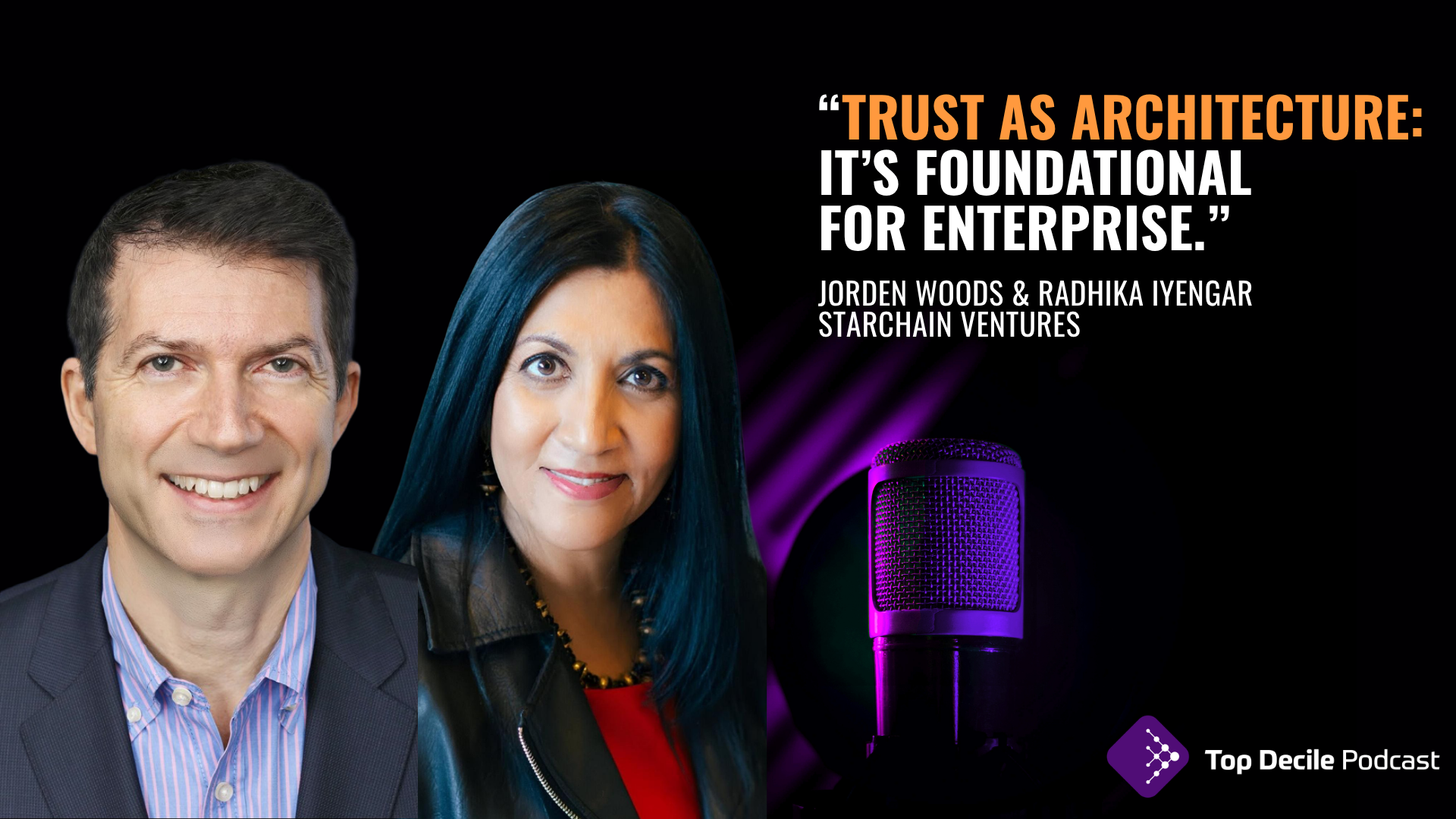
They Wrote the Book in 2019. Then They Built the Fund to Back It.
In 2019, two founders sat down and wrote a book predicting that AI and blockchain would converge into something nobody in venture was ready for.
The book was Enterprise Blockchain Has Arrived.
Then they spent the next six years building the track record to invest in it.
StarChain Ventures is what happened next.
Today, Jorden Woods and Radhika Iyengar are running a venture fund built around a thesis they wrote down seven years before the rest of the market caught up. The portfolio is already in motion, the deal flow is already tier 1, and the LP base is already aligned around the most coherent investment narrative in venture capital right now: AI Data Intelligence plus blockchain equals trust as architecture for the regulated enterprise stack of the next decade.
This is how they got here.
The Two People at the Head of This Fund
A fund manager team is usually one person plus an operator who helps run the model. StarChain Ventures is two operators with complementary depth and a shared seven-year track record before the fund even launched.
Jorden Woods is a Caltech astrophysicist and a multi-time founder with his own exits. Across his career, he's helped raise more than $50 million for his portfolio companies. Inside StarChain, Jorden leads the finance and tokenization side of the thesis: how real-world assets, money, securities, commodities, and IP get digitized and brought into agentic systems in a trustless environment.
Radhika Iyengar is a Top 100 Woman of the Future who has advised startups that generated $4 billion in shareholder value. She's also a multi-time founder. Inside StarChain, Radhika leads the healthcare, life sciences, and applied AI side of the thesis: how trusted data, blockchain integrity, and AI converge into measurable patient and business outcomes in regulated industries where failure is not an option.
Together, Jorden and Radhika aren't allocators looking at venture as a second career. They're operators who built in this space first, predicted the convergence, wrote the book on it, ran a venture lab for seven years to test it, and only then launched the fund.
That sequence is rare. It's also exactly the kind of track record sophisticated LPs are spending 2026 looking for.
Trust Is Architecture
The StarChain thesis is one line.
AI Data Intelligence plus blockchain equals trust as architecture for the regulated enterprise stack.
Pull that apart and the logic compounds.
AI is fundamentally a data play. The best models in the world fail on bad data. In high-stakes regulated industries like finance, healthcare, defense, and energy, bad data isn't a performance problem. It's a liability problem.
What blockchain provides is the architecture of trust around that data: integrity, security, privacy, confidentiality, governance, and an audit trail that's immutable and tamper-resistant.
"If you look at this architecture that is trust-based, then it really has to have something like blockchain to provide that layer of trust. These are must-haves. These are not things you can add later." — Radhika Iyengar
"Blockchain also gives you the ability to take real-world assets and tokenize them. Money, stocks, bonds, commodities, property, IP. There is nothing better for AI than digital. If you want agentic systems operating on real-world value, they need digital infrastructure they can trust." — Jorden Woods
Trust as architecture is the line that captures everything StarChain Ventures is built around.
Why Now: The Databricks Signal
The fund didn't launch in 2019 when Jorden and Radhika wrote the book. It didn't launch in 2021 or 2022 either. They were deliberate about the timing.
The signal that pulled them in was Databricks closing $10 billion at a $60 billion post-money valuation at the end of 2024, now valued at around $134 billion.
For StarChain, Databricks was the proof that Enterprise AI had finally arrived. Their thesis required both Enterprise AI and Enterprise Blockchain to be in motion at the same time. Databricks closed the loop.
In their own framing: Enterprise AI is here. Enterprise blockchain is arriving. Data intelligence is the bridge. Now is the right time to deploy capital against this convergence.
That clarity of timing is exactly the kind of thinking LPs are paying for.
The Profit With Purpose Mantra
StarChain Ventures runs on a single operating mantra: profit with purpose.
Most "purpose-driven" funds either compromise returns for impact or use the impact framing as a marketing layer. StarChain treats profit and purpose as the same conversation.
The bet is that the companies solving the highest-stakes problems in the largest regulated industries, including finance, healthcare, energy, and defense, are also the companies generating the largest returns. The proof point is in the portfolio.
PaySoko Systems: The Proof Point
PaySoko Systems is the StarChain portfolio company that captures the thesis most clearly.
PaySoko uses AI plus blockchain to de-risk small business lending for community banks. Community banks have a mandate to fund small and medium businesses, but most SMBs younger than two years old don't have any credit history a bank can rely on. The result is a high cost of underwriting, high default rates, and a structurally underserved customer base.
PaySoko's combination of trusted data through blockchain and advanced underwriting through AI lets community banks offer hyper-personalized loans tailored to each small business. The current default rate on the platform is under 0.2 percent.
The technology stack is the moat. The bank's economics shift from unprofitable to profitable. The small business gets the loan. The borrower's data stays trusted. PaySoko is already operating across the United States and East Africa.
"At the end of the day, the customer doesn't say 'wow, what a great technology stack.' The customer says 'wow, this solves a really big problem I have.' That's the test for every investment we make." — Radhika Iyengar
The Pipeline Is Real
PaySoko is one company in a tier 1 pipeline.
StarChain's deal flow includes companies operating across:
Hyper-personalized lending and financial inclusion (finance + AI + blockchain)
Real estate and property tokenization (tokenization + agentic systems)
Healthcare data intelligence and personalized medicine (regulated AI + privacy infrastructure)
Supply chain and commodity tokenization (industrial AI + audit infrastructure)
Agentic workflows operating on tokenized real-world assets (the convergence frontier)
Every one of these sits at the intersection of AI Data Intelligence and Enterprise Blockchain. Every one of them is solving a problem in a regulated industry where trust as architecture is the requirement, not the upgrade.
The Fund Economics LPs Should Know
Jorden and Radhika are clear-eyed about the math LPs care about.
Top decile micro venture funds return 5x to 7x. Mega funds return 1.8x to 2.5x.
The math compounds for a reason. Small funds need a single unicorn to return the fund. Mega funds need a hectacorn, a $100 billion outcome, to move the needle. There are thousands of unicorns. There are very few hectacorns. The probability math favors the micro VC structure.
"We can return the fund multiple times with a small number of well-selected deals. A mega fund cannot. The economics across every decile of returns favor a smaller, sharper fund." — Jorden Woods
Add to that the operator advantage. New fund managers have to prove themselves with every deal. There's no room for casual investing. The hunger and scrutiny that come with Fund I are exactly the conditions that produce above-average returns when paired with a defensible thesis and operator depth.
StarChain has all three.
What LPs Should Look For in This Fund
The LP brief in their words:
Specialized expertise. Deep technology depth in both AI and blockchain, and an applied understanding of how that stack lands in regulated enterprise contexts.
Operator track record. Both Jorden and Radhika have built and exited inside the technology stack StarChain invests against. They aren't predicting how this works. They've lived it.
Intelligent portfolio construction. This isn't angel investing or SPV syndication. It's curated, concentrated portfolio construction backed by a defensible thesis.
Profit with purpose alignment. LPs who care about returns and about where the returns come from will find the cleanest fit here.
Already-tier-1 deal flow. Not theoretical. The pipeline is in motion and the portfolio is already deploying.
"We're going to have a herd of unicorns." — Radhika Iyengar
The VC Lab Story
StarChain Ventures launched through VC Lab.
Jorden and Radhika had explored launching a fund several times across their careers and had pulled back each time when the timing or the values alignment wasn't there. VC Lab's structure, including the Mensarius Oath, the focus on ethical investing, and the commitment to backing emerging managers who prioritize alignment over speed, was the signal that this was the right launch path.
"Decile Group's VC Lab program with the Mensarius Oath, the focus on ethical investing, that was a very positive signal. Out of that signal came this storm of activity that led one thing into the other." — Radhika Iyengar
The VC Lab playbook compressed the StarChain launch from a multi-year process into months of execution. The PACT structure for committed LPs, the Decile Hub back office, the fund admin running on agents, and the fundraising sprints all pulled the first close from "we're talking to LPs" to "we're wiring funds" in months instead of years.
Now StarChain is in market and operating on the same infrastructure that has powered over 1,000 emerging fund managers around the world.
Why Jorden and Radhika Are the Pattern
If you read the StarChain story carefully, the lesson is the one every emerging fund manager should hear.
They didn't launch a fund the moment the opportunity appeared. They wrote the book first. Then they ran a venture lab for seven years to pressure-test the thesis. Then they waited for the macro signal, Databricks, that confirmed the timing. Only then did they launch.
That kind of patience is rare in venture. It's also the reason their Fund I deal flow is already tier 1. They've spent seven years building the network, the credibility, and the conviction. Now they're deploying against it.
For LPs, that means you're not betting on a thesis. You're betting on a thesis with seven years of validation behind it.
For founders building at the intersection of AI and blockchain, you're not pitching a fund. You're pitching the people who wrote the playbook for the category.
Watch the Full Interview
- Top Decile Podcast