Top Decile Podcast: Eran Savir
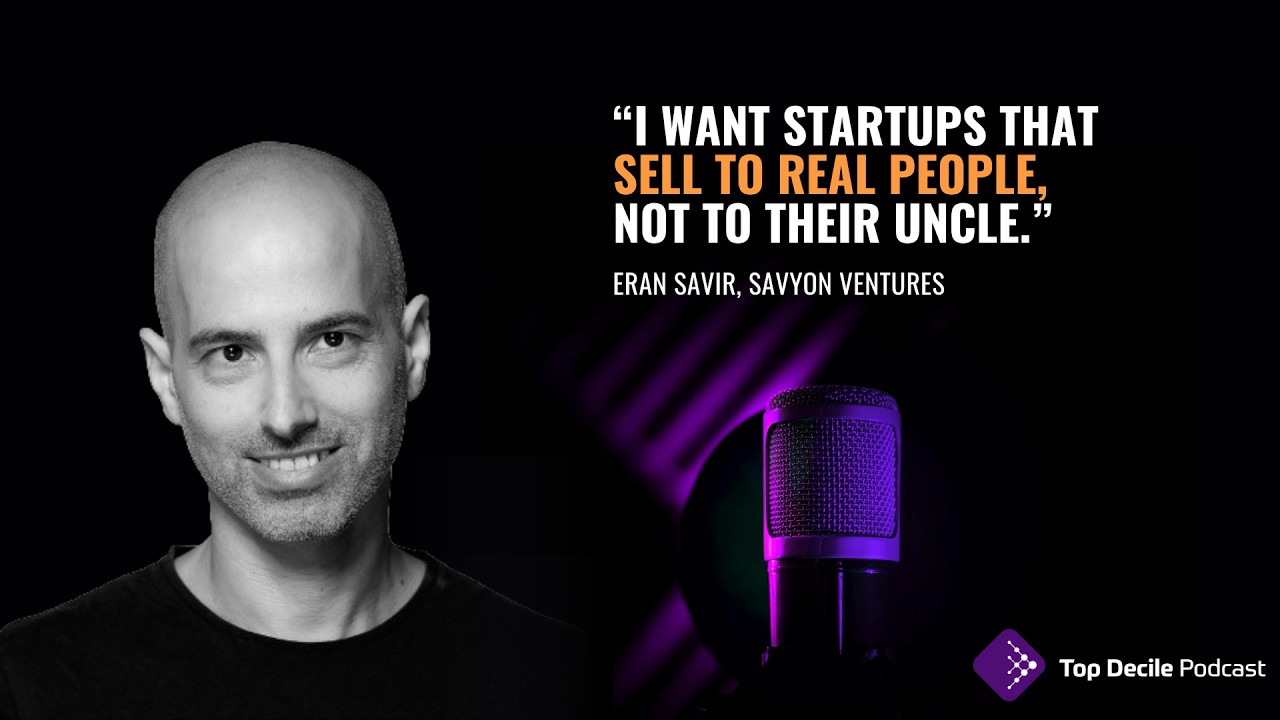
Most seed investors treat a great founding team as the whole thesis. Back the right people, the reasoning goes, and they'll figure the rest out. Eran Savir doesn't buy it.
Watch The Full Episode Here: https://www.youtube.com/watch?v=NOOnKOvACM8
"Sometimes great teams don't figure it out and then you as a VC you lose your money," he said on the Top Decile Podcast, in conversation with host Connor Sattely of Decile Group. Then, plainly: "I don't enjoy losing money."
That single line explains most of what makes Savir's approach distinctive. He's a three-time founder with two exits who spent years building and running seed funds before launching Savyon Ventures, an early stage fund in Israel backing AI, digital, and e-commerce companies. He brings decades of experience and a strong track record to the seat. And he's built the whole practice around a refusal that separates him from a large part of the seed market.
A Great Founder Isn't the Thesis
Plenty of investors take pride in speed. Savir treats a fast yes as a warning sign about his own process, not a badge.
"It's not that I don't wanna make, I don't want to invest faster, it's just that I wanna be like almost hundred percent sure that this is like an amazing investment," he said. That means time with customers, references, and industry experts, even in categories he already knows well. It also means time simply passing, so both sides learn what the working relationship will actually feel like after the wire clears.
But the deeper point is what he requires on top of a strong team. "The fact that the founder is is great, this is like given," he said. For Savir, conviction in the people is table stakes at the seed stage. The differentiator is conviction in the business as it exists right now.
"I really invest in businesses that I understand," he said. Not businesses a talented team might eventually invent, but businesses whose dynamics he can already read, in markets whose shape he can already see.
The Uncle Test
So what counts as evidence? Savir invests after initial revenue, and he's spent enough time being asked to define that phrase to have developed a memorable answer.
There's "like a massive difference between those who sell to what I call like their uncle and like to real people," he said. A friend of a friend is fine. A warm introduction is fine. What matters is why the money moved. If someone bought because they're doing you a favor, that's not a market. If someone bought because the product solved a problem they have, that's a signal.
And the signal has to be denominated in cash. "It solves a problem and they're also willing to pay like real money and I'm waiting to see the money in the bank," he said. In B2B, that looks like multiple transactions from real customers wiring real money. In B2C, it looks like a genuine acquisition motion producing genuine orders, whatever the basket size.
Savir frames this less as investor discipline than as founder self-defense. Having built companies himself, he's blunt about the cost of skipping the test: "You don't want to spend your time, your life, whatever your most important years on building something that maybe no one wants and needs."
His conclusion is unsentimental. "Everything else is just like a supporting evidence but just revenue is like the real thing."
Two Types of Founders
Early in his investing career, Savir started sorting founders into two groups, and the split has held up.
One group dreams. They can describe an enormous company and they may genuinely build one, but revenue stays theoretical. The other group builds businesses. They treat income exceeding expenses as the obvious objective rather than a later problem, and they push toward break-even early.
That second group, in his experience, is also the tougher one. In a downturn, they'll "keep the company running, keep the lights on." They find a way to make money because making money was always the plan. And in an era when AI lets small teams ship faster than ever, Savir thinks that group can reach sustainability sooner than founders of previous cycles could.
An Eclectic Portfolio That Isn't
Look at the Savyon Ventures portfolio and the first impression is variety. A direct-to-consumer apparel brand selling into the US. A reusable building-brick kit that ships kids a new project each week alongside a digital lesson in physics and mechanics. AI-powered customer support. Automated tax filing and refunds for small businesses in Europe. AI-driven collection of small consumer debts too minor for anyone to chase by hand.
Savir says that reading misses the actual filter. "We're not a generalist fund," he said. "We're looking for fast growing internet companies at the seed stage."
That's the through line. The B2B companies tend to sell to mid-market and smaller customers, which produces a particular revenue-growth dynamic. The consumer companies are run by founders fluent in CAC, LTV, and payback period. Across every one of them, the question is the same: can this grow revenue fast, and is there proof it already does? Some Fund One companies are already profitable or could be if they chose to, which Savir ties directly to value creation. "The valuation grows faster when you get to the break-even point," he said.
The categories look scattered. The economics don't.
Raising a Fund Is Harder Than Raising for a Startup
Asked how fundraising for a fund compared to fundraising for his startups, Savir didn't hedge: "Significantly harder and more difficult."
The sourcing, filtering, and investing carried over. Convincing LPs didn't. A founder tells a story about a problem and a solution, and people can picture it. A fund asks for something else entirely. "They need to commit to joining you in advance without really knowing what's gonna happen," he said. "They really need to trust you in a way."
The surprise came from where commitments actually originated. Repeat LPs said yes early, as expected. But so did people he'd known across the industry for a decade or more and hadn't spoken to in years, some of whom had never liked a post or answered an early email. Several told him some version of the same thing: "I was actually waiting for you to approach me."
Two archetypes dominate the LP base. The first is exited tech founders and angels seeking exposure to early stage, high conviction deals. Many "got tired of losing money as angels and so they hand their kind of angel budget to a fund and then they co invest with the fund," Savir said. The second is high net worth business owners who want exposure to Israeli tech and AI but have no path to quality deal flow on their own. Both groups get co-investment opportunities alongside the fund.
About Savyon Ventures
Savyon Ventures is an early stage seed fund based in Israel, investing in AI, digital, and e-commerce companies that have already shown real revenue from real customers. The fund concentrates on fast growing internet businesses across B2B, B2C, and D2C, and offers its LPs co-investment opportunities alongside the fund.
Eran Savir is the Founder and Investment Lead of Savyon Ventures. A three-time founder with two exits, he spent years building and running seed funds before launching Savyon, and brings decades of operating and investing experience to the firm.
Watch The Full Episode Here: https://www.youtube.com/watch?v=NOOnKOvACM8
- Top Decile Podcast
- Case Study