Top Decile Podcast: Javier Cueto
Most venture pitches open with the promise of a unicorn. Javier Cueto opens by taking that promise off the table. "We are not looking for unicorns as a mandatory thing," he tells his LPs. From someone who has spent more than a decade watching Latin American startups succeed and fail up close, that isn't modesty. It's math.
Watch The Full Episode Here: https://www.youtube.com/watch?v=ajYs5_6mc98
Cueto is the Founder and Investment Lead of Imagine Ventures, a pre-seed and seed fund backing the future of work and the future of finance across Latin America. He joined Connor Sattely on the Top Decile Podcast to explain why running the Silicon Valley playbook outside Silicon Valley disappoints everyone.
A Career Spent Entirely in Uncertainty
Cueto arrived at venture from thirteen years building the earliest stage of the ecosystem itself, starting at a university incubator. "I've never worked in a corporate, I've never worked like in an established company," he says. "I've always been involved with entrepreneurs, with startup, with investors, at the end with uncertainty."
That history produced the track record he now runs on. The incubator he helped build launched in Chile in the early 2010s, when the region had university programs and government support but, as he puts it, "we didn't have any players from the private sector." Partnered with Microsoft and backed by a government fund, the team reviewed more than 10,000 startups and invested in roughly 120, with what Cueto calls "almost 30% survival rate, which is pretty high" for ideas that were "literally a PowerPoint presentation."
The allocation discipline is the part worth stealing. Capital wasn't spread evenly. "Our money allocation was like two-thirds of the fund went to the third that survived," he says. Checks scaled with milestones, and bigger ones were earned with revenue, clients, and outside investors.
The Case Against Copying Silicon Valley
The thesis Cueto now takes to LPs is built on a refusal. "We don't have to copy Silicon Valley because we are not Silicon Valley," he says. The Valley has a stack of conditions that don't replicate: the universities, the corporates, the market, the capital. Chasing the same outcomes without them produces funds that promise IPOs and deliver nothing. "We are not looking for IPOs as a part of the thesis," he says, because even there that outcome is the exception.
What the region offers instead is acquirers. Strategic buyers from Europe and North America are buying technology companies across Latin America, and exits that would barely register on a Silicon Valley cap table can move a small fund. So the target changes. "We are not looking for one company to pay the entire fund. What we are looking is to have hopefully more than half our portfolio live with a sustainable model growing and that they could be attractive to sell," he says. The arithmetic follows. "If that happens in not one or two startups, it happens in five or six, then at the end you get the same return."
He's blunt about the cost of getting this wrong. Funds that launched a decade ago on unicorn logic now face LPs with nothing to show for it. "We invested five, seven years ago, we haven't seen a single dollar," he says, repeating feedback that every manager raising behind them inherits.
Why the Region Is Worth the Work
Cueto's optimism rests on three structural points. The first is pricing. "You can invest in a startup with more traction and with half the valuation," he says, and if that company scales into the US or Europe, the markup compounds from a lower base. The second is scale without translation: "We share a language," which makes crossing borders far easier than in Europe. The third is the gap itself. "Corporates still are too traditional, the technology adoption is pretty low." That gap is the hunting ground, and it points straight at productivity and at people.
What the Thesis Looks Like in Practice
Future of work, in Cueto's hands, is broader than software for HR teams. "A lot of people just focus on future of work like HR and it's more than that," he says. "It's way more profound than that."
The portfolio shows the range. One company handles the logistics of equipping employees hired anywhere, a model born of post-pandemic hiring, and he calls it profitable and the fund's largest position. Another works on mental health, because "it's not just productivity, it's just not adopting technology, it's also like caring about people." On the finance side, one delivers microloans to employees through their employers.
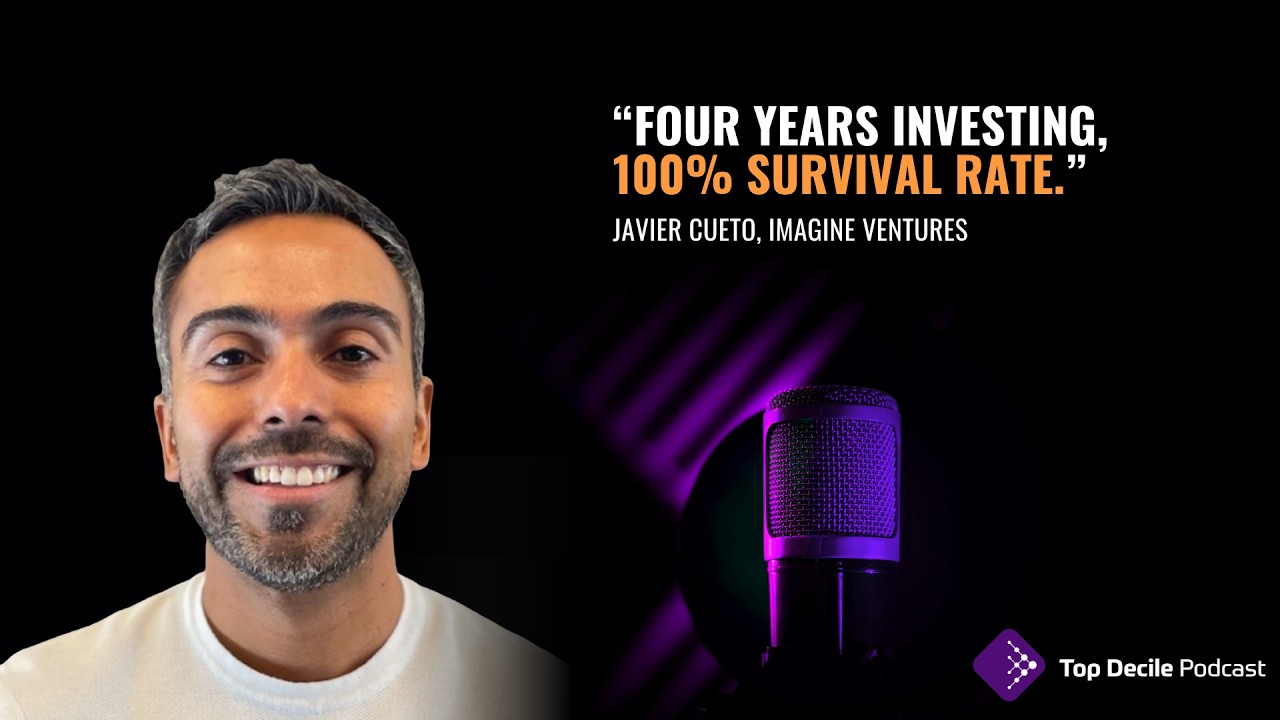
The portfolio has held together better than he modeled. "We've been investing for four years and we have a hundred percent survival rate," he says, then checks himself: "We know that's not going to be a hundred until the end."
He's also adapting to what AI is doing to moats. "The barriers of entry are lower. So we are focusing a lot on what are the barriers of exit," he says. That favors pairings that used to look unfashionable: "Hardware was really unsexy and now this mix hardware and software is becoming sexier."
Advice for the Next Fund in the Region
Asked what he'd tell someone starting a similar fund, Cueto reaches for credibility rather than tactics. "Unfortunately people are pretty traditional in investing," he says of his market, and inspiration alone doesn't close checks there. "You need to show that at the end you have the network, you know what you're doing, you have the track record."
His practical answer is community. "Create community that at the end gets to know you, gets to know what you're doing, gets to know your track record, show that you can provide more than financial value." For the first fund, that meant master classes for LPs, many of them new to venture. And patience. "If they tell you, hey, the US in four months you can do a first closing, just double that time in Latin America," he says. "Things take time, people are more traditional and more conservative."
About Imagine Ventures
Imagine Ventures is a pre-seed and seed venture capital fund investing in the future of work and the future of finance across Latin America. It grew out of more than a decade of early stage ecosystem building in the region, including an incubator practice that reviewed thousands of startups at the idea stage. The fund backs founders working on productivity, technology adoption, well-being, and financial inclusion, with a strategy built on sustainable growth and realistic exit paths rather than unicorn hunting.
Javier Cueto is the Founder and Investment Lead of Imagine Ventures. He has spent his entire career working with early stage founders and investors in Latin America, and brings a strong track record in ecosystem building and early stage investing.
Watch The Full Episode Here: https://www.youtube.com/watch?v=ajYs5_6mc98
- Top Decile Podcast
- Case Study