General Solicitation Rules for VC Fund Managers 2026 - VC Lab
· By Decile Group · Insights

What VCs need to know about General Solicitation in 2026
In countries around the world, there are rules and regulations that govern pitching limited partners (LPs), the investors in venture capital funds. Publicly pitching for investment, called General Solicitation, is commonly regulated, and it is important for new managers to understand the local rules and regulations.
This is a practical overview of general solicitation for venture capital fund managers. This overview is not legal advice, and fund managers are encouraged to read the Legal Disclaimer.
Before you launch a web site, post on social, or send out a presentation, make sure you understand the general solicitation laws.
What is General Solicitation?
"General solicitation" refers to raising capital by making public statements and soliciting interest from strangers. While general solicitation can be applied to various forms of fundraising, this overview focuses on venture capital.
The general solicitation regulations are in place to protect average citizens from having their savings lost by savvy fund managers promising large returns from high-risk and often illiquid investments. Most governments believe that wealthy and sophisticated investors, referred to as "accredited investors" in the U.S., can take risks with their capital on speculative opportunities.
General solicitation is regulated by the Securities and Exchange Commission (SEC) in the U.S. and by AIFMD in Europe under "pre-marketing" rules. The regulations vary widely around the world by country, including how they are applied. The regulations of some countries apply to citizens anywhere in the world. As an example, a U.S. fund raising from European limited partners will need to comply with both the U.S. and the European rules, which can get complicated.
How do you avoid General Solicitation?
Here are some best practices for pitching limited partners as a series of Do's and Don'ts.
The Do's
Do have a pre-existing relationship with a potential limited partner before pitching them by, for example, waiting a few days between a first meeting and the pitch
Do have a substantive relationship with a potential limited partner before sharing fund materials by, for example, understanding their investment experience and sophistication
Do pitch limited partners that you reasonably believe are wealthy with the means to lose the investment
Do personalize messages to each potential limited partner versus sending mass emails
The Don'ts
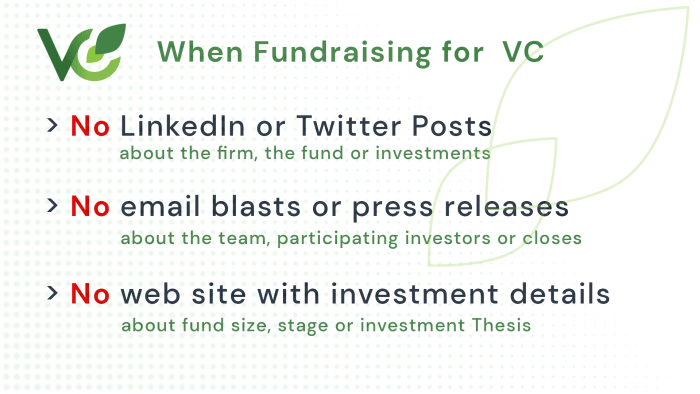
Don't make public statements, share fund information on social or issue press releases while fundraising
Don't have a public fund website with your investment thesis or with a contact link while fundraising
Don't send out materials and presentations to people that you do not know or have connectors send materials on your behalf
Don't speak at events, seminars, webinars or meetings where strangers are invited and where you talk about the fund Thesis or investments while fundraising
Don't reach out beyond your social, personal or professional network of close friends and colleagues without establishing a relationship first
These best practices are meant to compliment advice from local lawyers familiar with the general solicitation regulations.
TIP: When asking advice from lawyers, don't ask if you can do something, but, rather, ask how to do something.
How do you raise money without General Solicitation?
It is vital to first establish a relationship and assess the investor's wealth and sophistication before discussing your fund. Here is an ideal situation to meet and close a limited partner.
First, you meet a prospective limited partner, ideally through a qualified introduction.
Next, you get to know them (i.e., the preexisting relationship), and you come to understand that they are wealthy and that they are suitable for illiquid investments (i.e, the substantive relationship).
Then, after some time, you discuss that you are launching a fund and review your fund strategy without revealing all of the details on the planned fund.
Lastly, the limited partner prospect requests more information on your fund, and you share the materials, which inspires an investment.
This ideal situation does not always happen in practice. Some important things to encourage in every situation are that (1) you establish a relationship first and that (2) you believe that they are wealthy and sophisticated.
NOTE: In Europe, check the regulations of the EU and the Country of the parties involved. Sending materials can be considered pre-marketing, which is regulated.
What happens if you break General Solicitation laws?
Depending on the jurisdiction, anyone can report you for a violation, and the local authorities can initiate an investigation at any time.
Legal Implications
Breaking general solicitation laws can lead to serious repercussions:
Investigations: Anyone can report a violation, leading to investigations by local authorities.
Penalties: Consequences may include complex legal proceedings, unwinding of investments, fines, and penalties. In the U.S., violators may be barred from raising funds for 5-10 years, with variations across jurisdictions. In Europe, violations can be prosecuted as a criminal offense.
NOTE: US firms should not pitch European limited partners without understanding the rules and regulations (see below), Europe is more strict.
Common Questions on General Solicitation
When can I speak publicly about the fund?
Post-Fundraising Publicity: Speak about the fund publicly only after it is fully raised and closed.
Event Participation: You can speak at events but avoid mentioning fund-raising or discussing the fund's specifics.
Can I speak at an event?
Yes. But, you can't say that you are raising a fund or selling securities, let alone or discuss the fund Thesis. You can put your title and fund name as your role, and you can discuss strategic insights that you are seeing.
Can I tell my close friends and family about the fund?
Yes. However, do not ask them to invest or participate in the fund unless they are wealthy and meet local accreditation standards and other regulatory requirements.
What happens if someone unqualified asks me about my fund?
Tell them that you are not able to disclose details of what you are working on due to general solicitation rules. If they press the matter, tell them that they are being inappropriate and potentially hurtful to your activities.
Can I share anything about my fund on Social Media?
No. Don't share that you are thinking to raise or actually are raising a fund. Don't share the fund name. Don't share that you are looking for limited partners. Don't share that you are doing any deals.
Why do people share about their funds on social media?
There are two reasons. First, they are violating general solicitation rules. Second, they are complying with special regulations that allow general solicitation, such as rule 506(c) in the U.S.
Should I try to comply with special general solicitation rules to market the fund?
VC Lab does not recommend this strategy at the moment. Most firms that use legal versions of general solicitation appear unprofessional, and general solicitation traditionally attracts smaller or unsophisticated limited partners.
Can I email or call people that I don't know and ask them to invest?
No. You need to have a pre-existing and substantive business relationship before discussing your fund strategy with someone. You can meet anyone and build a relationship without mentioning the fund. You can discussing strategies and past investment experience without revealing key information about your fund Thesis, such as fund size. Then, ideally, the person asks you for information on the fund.
Can I Discuss Future Fund Plans in Interviews?
Be cautious in interviews and avoid specifics about upcoming fundraising plans or details about the fund that could be interpreted as solicitation.
How Do I Handle Inquiries from Potential Investors I Meet Publicly?
If approached by potential investors in public settings, it's best to schedule a private meeting to discuss the fund, ensuring that general solicitation rules are not violated.
Are There Exceptions to These Rules for Repeat Investors?
While existing investors might be familiar with your fund, it's important to follow the same protocols for new and repeat investors to ensure compliance with solicitation rules.
Is It Safe to Share Fund Performance Data Publicly?
Publicly sharing fund performance data while fundraising might be construed as a form of general solicitation. It is safer to share such information only in private settings with accredited investors
Local Regulations
General Solicitation in the U.S. as Governed by the SEC
Overview of SEC Regulations
The U.S. Securities and Exchange Commission (SEC) governs general solicitation under the Securities Act of 1933. With the implementation of the JOBS Act, significant amendments were made to Rule 506 of Regulation D and Rule 144A, allowing more flexibility in capital raising while ensuring investor protection.
Key Aspects of Rule 506(c) of Regulation D
Permissible General Solicitation: Issuers can use general solicitation under Rule 506(c), provided all investors are accredited and their status is verified.
Accredited Investor Criteria: Includes individuals with specific income or net worth and entities meeting certain criteria.
Verification of Accredited Investor Status: Issuers must take reasonable steps to verify the status of investors, with the SEC providing a non-exclusive list of methods for such verification.
Rule 144A Amendments
Rule 144A Scope: Initially for resales of securities to Qualified Institutional Buyers (QIBs), the amendments now allow general solicitation under certain conditions.
Offering to Non-QIBs: Securities may be offered to non-QIBs using general solicitation, but sales must be exclusively to QIBs or those reasonably believed to be QIBs.
Compliance and Best Practices
Responsibility of Issuers: Issuers using general solicitation must adhere strictly to the verification requirements and other conditions of the amended rules.
Investor Protection Focus: The SEC aims to balance capital formation with the need to protect investors from risks associated with unregistered securities.
General Solicitation in Europe as Governed by Pre-marketing Rules
Harmonization of Pre-marketing Rules in the EU
he European Union implemented harmonized pre-marketing rules for collective investments on August 2, 2021. These regulations apply to licensed capital management companies and managers of European Venture Capital Funds (EuVECA) and European Social Entrepreneurship Funds (EuSEF) operating within the EU.
NOTE: Once a fund manager has interest from a potential limited partner without sharing materials, then the manager should consider starting the notification process outlined below.
Definition and Scope of Pre-Marketing
Pre-Marketing Defined: The Alternative Investment Fund Managers Directive (AIFMD) defines pre-marketing as providing information about investment strategies to potential professional investors in the EU. This applies when an EU Alternative Investment Fund Manager (AIFM) aims to gauge interest in: a fund that has not yet been established or an existing fund that has not been notified for marketing in the relevant Member State.
Eligibility for Pre-Marketing: These rules apply to authorized EU-domiciled AIFMs marketing towards potential professional investors within the EU.
Restrictions: Pre-marketing materials must not:
Enable investors to commit to purchasing fund units or shares
Include subscription forms or similar documentation
Contain final constitutional documents, prospectuses, or offering documents for funds not yet established
Notification and Reverse Solicitation
Notification: Fund managers (AIFMs) must notify their home member state's competent authorities within two weeks of starting pre-marketing activities, including:
The member states where pre-marketing will occur
The time periods of pre-marketing activities
A brief description of planned pre-marketing activities
Reverse Solicitation: Reverse solicitation occurs when an investor independently contacts a fund manager to invest in a fund without any prior marketing or pre-marketing by the manager. Under the new EU rules, any investor subscriptions within 18 months of pre-marketing activities are automatically treated as resulting from marketing efforts, not reverse solicitation, even if the investor claims otherwise. This effectively prevents firms from circumventing marketing rules by claiming reverse solicitation.
Third-Party Pre-Marketing and Non-EU AIFMs
Third-Party Involvement: Only authorized fund managers (AIFMs), investment firms under MiFID II, credit institutions, UCIT management companies, or tied agents under MiFID II can engage in pre-marketing on behalf of an authorized AIFM.
Non-EU AIFMs: Currently, the provisions apply only to EU fund managers (AIFMs) with EU AIFs. However, they may eventually be transposed into national private placement rules, impacting third-country fund managers as well.
EuVECA Funds: The rules for pre-marketing of EuVECA Funds align with those for AIFs, but specific national implementations may vary.
- LP Strategy
- Legal Support